Trash Pickup
Take out the trash and help care for the environment
Take out the trash and help care for the environment
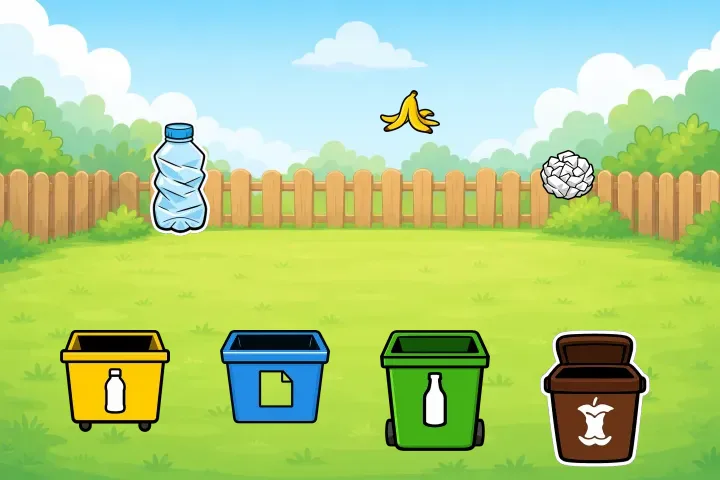
An environmental care game for little ones: every scene has trash that shouldn't be there. Catch it with the net, drop it in the bin and watch the place shine again — the water gets clearer with every piece you collect, and when you finish, the animals come out to celebrate. Careful: the fish, the turtle, the octopus and the plants can't be picked up — they live there, and if you touch them with the net they'll let you know. A fun way to learn about recycling and caring for nature, with no reading and no complicated rules.
You can play on two levels: Easy, with just a few big pieces of trash and a bin that helps you score, designed for toddlers ages 2 to 4; and Hard, with more trash for kids ages 5 to 8. Every round is different — the trash appears in new places — so you can play again and again.
Trash Pickup is free, runs right in the browser with nothing to download, and is available in English, Spanish, Portuguese and French. Great for home or the classroom as a first environmental education activity. If you are looking for environment games, recycling games or activities to talk about pollution and environmental education with kids, this is a perfect place to start.
It's designed for kids ages 2 to 8, with two levels that grow with them. The Easy level is ideal for toddlers (ages 2 to 4): there are just a few pieces of trash, they show up nice and big, the net catches with a generous radius and the bin works like a magnet that helps them score — the goal is a guaranteed-success experience. The Hard level, for kids ages 5 to 8, adds more pieces of trash at regular size, so they have to search more carefully, aim with more precision, and finishing the clean-up takes longer. Since the trash is shuffled into different spots every round, the game never runs out: each round is a fresh scene to sweep from end to end.
The most important part is the environmental message, delivered without lectures: trash doesn't belong in nature, and removing it has a visible effect — the scene starts out murky and dirty and brightens with every piece that goes into the bin, until the whole place gets its colors back and the animals celebrate. Kids also learn to tell trash apart from living creatures: if they try to catch a fish or a plant with the net, the animal shakes and lets them know it's not allowed, because it lives there. On the motor side, dragging the net with the mouse or a finger, holding the trash and carrying it to the bin trains fine motor skills, hand-eye coordination and sustained attention.
Yes, the game is designed to work equally well with a mouse and with fingers. On touch screens the net appears right where the child puts their finger and follows it with a smooth motion, and there's a fullscreen button to use all the space and avoid accidental taps on the browser. There's also an alternative tap mode for the littlest ones who can't drag yet: they tap a piece of trash to select it (it floats and glows) and then tap the bin — the trash flies in by itself. Both modes coexist with no setup: the game understands whichever gesture the child makes.
It's 100% free, with no sign-up, no downloads and no in-game purchases: it opens in the browser and you play instantly, like every game on Little Kids Games. It's available in English, Spanish, Portuguese and French, with the instructions spoken out loud in each language for kids who can't read yet. It works on computers, tablets and phones, and since it's a browser game it's always up to date without taking up space on the device. That also makes it a great option for the classroom: teachers can project it or hand it out on class tablets without installing anything.
Yes — that is exactly what it is: an environment game designed for kids ages 2 to 8. It shows pollution in a simple, visible way (a dirty place that looks dull) and works on the three core ideas of early environmental education: trash does not belong in nature (recycling), animals and plants are respected (caring for nature), and the effort of cleaning has a visible result (the scene gets its colors back). The 6 scenes — sea, beach, park, campsite, city and school playground — cover the environments kids know, from everyday places to nature.