Tic-Tac-Toe for Kids: Strategic Thinking Through 3 in a Row
Choose between 3 difficulty levels against the computer.
Tic-Tac-Toe (also known as Noughts and Crosses or X's and O's) is one of the classic games most recommended for introducing kids to strategic thinking. Kids face a 3×3 grid where they must align three matching symbols (X or O) horizontally, vertically, or diagonally before the computer does. It's simple to understand, fast to play, and develops fundamental cognitive skills like anticipation, spatial logic, and decision-making under turn-based constraints.
Three modes designed to support learning: Easy (random CPU moves, ideal for ages 4-5 just learning the rules), Medium (CPU blocks obvious wins and takes opportunistic moves, for ages 6-7 with basic experience) and Hard (Minimax algorithm playing near-perfectly, for ages 8+ seeking real strategic challenge).
What benefits does Tic-Tac-Toe offer kids?
- Strategic thinking: anticipating your opponent's next move on a grid of just 9 squares
- Logical-spatial reasoning while lining up 3 matching symbols on the 3×3 grid
- Recognizing all 8 possible winning lines: 3 horizontal, 3 vertical and 2 diagonal
- Decision-making under constraint: players alternate turns and occupied squares can't be reused
- Building tolerance for frustration: games last 3 to 5 minutes and you can start a rematch instantly
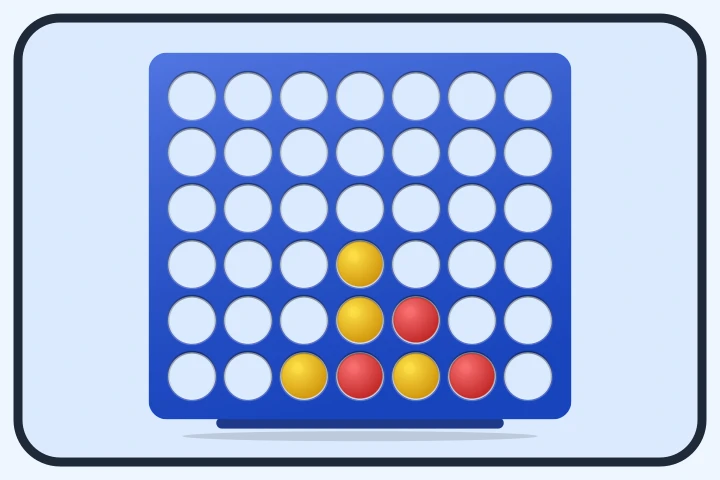
- Strategic foundations for more complex games like chess, checkers, gomoku or connect four
No invasive ads, no downloads, no signup. Works on phone, tablet, or computer in the browser. An activity parents, teachers, and grandparents can share with kids any time of day.
Frequently asked questions about Tic-Tac-Toe
What is tic-tac-toe and how do you play it?
Tic-tac-toe is played on a 3×3 grid. Two players take turns, one marking circles and the other crosses. The first to line up three of their own symbols in a row, a column or a diagonal wins. If all nine squares fill up without anyone lining up three, the game ends in a draw. In other countries it is called noughts and crosses, tres en raya or ta-te-ti.
What are the rules of tic-tac-toe for kids?
Three rules are enough: take turns, never mark a square that is already taken, and the first to line up three symbols wins. With younger children it helps to skip the strategy talk at first and let them discover on their own that the centre is the strongest square, because it belongs to four of the eight possible lines.
At what age can kids start playing tic-tac-toe?
Children can start playing tic-tac-toe from age 4 on the Easy level, where the computer makes random moves and lets the child explore the rules without getting frustrated. By that age they can already identify simple shapes and grasp the idea of taking turns. Between ages 6 and 7 they're ready for the Medium level, where the computer blocks obvious moves and pushes them to think two moves ahead. From age 8 they can take on the Hard level powered by the Minimax algorithm, which plays almost perfectly and teaches the child to look for the optimal move on every turn. We recommend short games of 3 to 5 minutes at first to keep their attention.
Why does the computer almost always win on the Hard level of tic-tac-toe?
The Hard level of tic-tac-toe uses an algorithm called Minimax that evaluates every possible future move and always picks the optimal one. Mathematically, in perfect tic-tac-toe the result is always a draw when both players play well, so the best you can hope for against Minimax is a tie, not a win. Even so, we added 5% random moves to the Hard level so kids can win every now and then and not get discouraged: that 5% works out to roughly 1 in every 20 games. What matters is that the child learns by watching how the computer defends the center, blocks the corners and sets traps with two simultaneous threats. That kind of observation teaches the optimal strategy through imitation, which is exactly the educational value of the game.
Is tic-tac-toe useful for learning strategic thinking?
Tic-tac-toe is the classic introduction to strategic thinking for children because it has very simple rules yet hides real tactical depth. Kids learn to anticipate the opponent's move, defend critical positions like the center and the corners, and create double threats that the rival can't block at the same time. These concepts are a direct foundation for more complex games like chess, checkers, gomoku or connect four. On top of that, tic-tac-toe builds tolerance for losing, a key emotional skill in childhood, because games last 3 to 5 minutes and you can jump into a rematch right away without frustration piling up. It's a game that grows with the child: at 4 they learn the rules, at 6 they spot obvious moves, and at 8 they understand the optimal strategy.
Does tic-tac-toe work offline or does it need internet?
Once the page loads for the first time, tic-tac-toe works completely offline in the browser. There's no app to download, it uses no data while you play, and the artificial intelligence runs directly on your device without sending anything to external servers. That makes it ideal for car trips, waiting rooms, flights or any situation without a stable wifi connection. You only need internet the first time you visit the site so the browser can cache the resources. After that you can reopen the page offline and play as many games as you like. For children's safety, tic-tac-toe collects no data about the child, shows no intrusive ads and never redirects to external sites during play.
Tic-Tac-Toe is one of the 11 logic games on Little Kids Games.