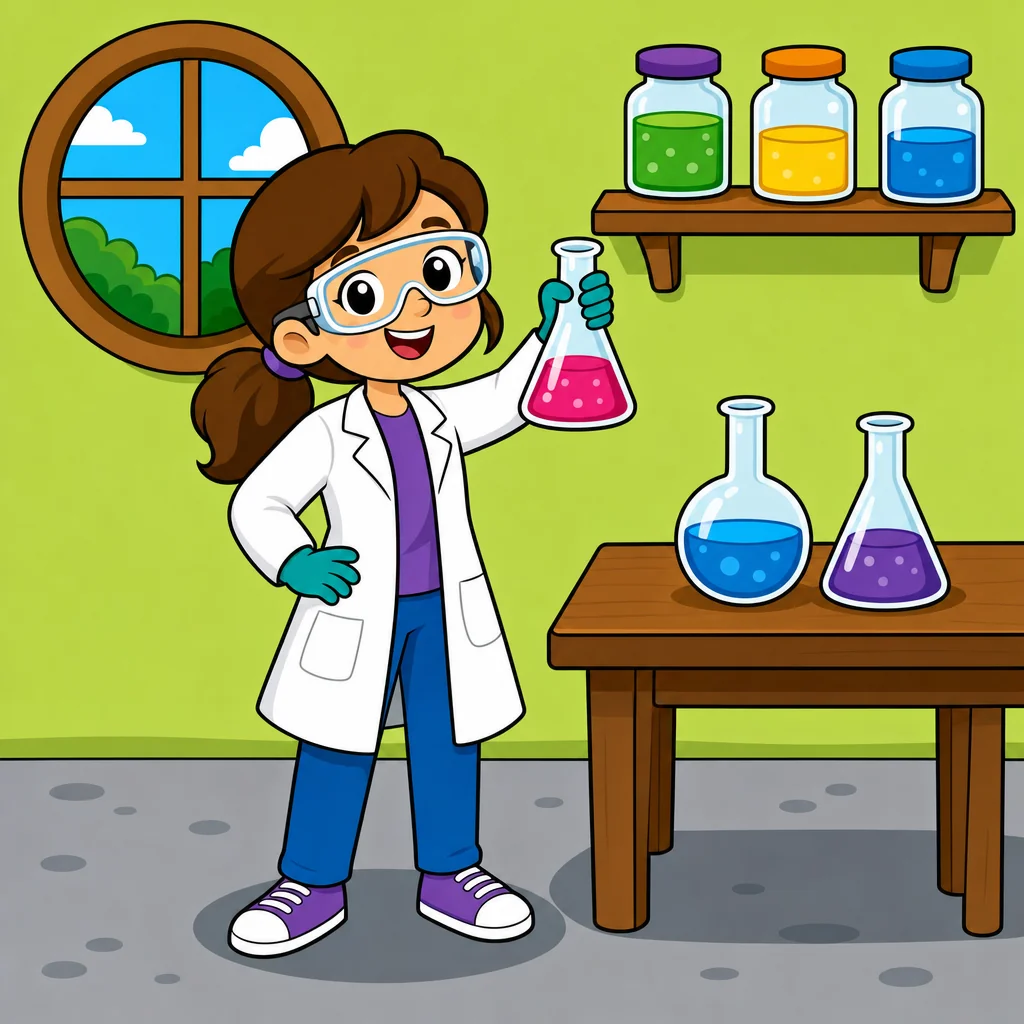
Scientist Puzzle for Kids Ages 2 to 8 (4, 9 and 16 Pieces)
How hard do you want to play?

How hard do you want to play?
Tap two pieces to swap them. When every piece is in place, you've solved it!
A laboratory smells of soap and cold, clean air, with a faint sharpness underneath, like the inside of a fridge that has just been opened. There is a low hum from a machine on the bench, the clink of a glass jar being set down, the squeak of a chair on wheels. The scientist ties back her hair and pulls on gloves that snap against her wrists, then writes something in a notebook before she touches anything at all. She looks into the microscope with one eye shut, turning the knob a hair at a time, and writes again. Around her sit small bottles with handwritten labels, a pipette, a tray full of little plastic wells. When the result surprises her, she writes that down too.
The Easy version of this Scientist puzzle has just 4 pieces on a 2×2 grid, made for children aged 2 to 3 who are starting to understand how parts make up a whole.
With so few pieces, kids complete the picture fast and feel a first sense of achievement without frustration. It is the ideal starting point for training hand-eye coordination and recognizing colors and shapes.
The Medium version of this Scientist puzzle splits the picture into 9 pieces on a 3×3 grid, a balanced challenge for children aged 4 to 5.
At this age kids can already picture how pieces fit together and learn to plan their moves. Nine pieces demand more sustained focus and build patience and spatial perception.
In its Hard version, the Scientist puzzle breaks into 16 pieces on a 4×4 grid, a challenge designed for children aged 6 and up.
Solving 16 pieces requires planning, comparing shapes and holding attention for several minutes. It is the level that trains problem-solving and frustration tolerance the most, with the big reward of completing a complex picture.


